Choosing to Suffer


I’ve gone snowboarding three times in my life–each time ended badly. The most recent time was at a winter retreat a few years ago. Some students invited me to join them for a great “bonding experience.” So I took a board, went to the top of the hill, strapped myself in, aimed in the right direction (because I didn’t know how to steer), pushed off, and prayed for the best.

At first I flew down the hill in the direction I had aimed for. Everything was going great. Then I noticed a younger student fifty or so feet in front of me struggling to free himself from his own snowboard and get off the course. In a split second I had to choose, run the kid over or lean to the side and eat it on the hill.

I remember thinking “I can crash gracefully…” so I chose the latter.  I leaned to the right to tumble softly into the snow–unfortunately I did not see the snow bank in my tumbling zone. I hit the bank with my board, flinging my body and board in different directions.  I then felt my right arm bend in the opposite way it is supposed to. And I thought I heard something pop.

Pain shot up my arm and through my elbow and up to my shoulder, as I now lie covered in snow at the bottom of the hill trying to figure out what just happened. I saw the kid walking away completely oblivious to my altruistic act. And of course the students I was with enjoyed bonding by retelling others how bad I ate it.

Now it turned out that after about 24 hours, a lot of ice, and a lot of Advil, I started to believe I might actually be okay.  But here’s the thing… if I had known at the beginning of the day the pain and humiliation that was waiting for me at the bottom of the snow-covered  hill, I would have never gone snowboarding that day. “Bonding,” no matter how great, just would not have been worth that much pain.

I think most of us would react the same way. If we knew something painful was coming in our day, we would try to avoid it. We would try to change it.  For most of us, if we know that a situation has the potential to end badly, we avoid it altogether. Even if there’s a potential payoff.

Because who wants to suffer? Who chooses to suffer?

Jesus did.

What is amazing to me about Jesus is not that he suffered, but that he knew he was going to suffer and he chose to go through it 480px-Michelangelo's_Pieta_5450_cropncleaned_editanyway.
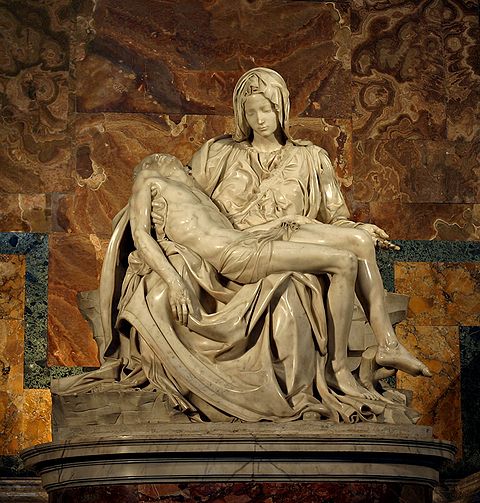
As a young Jewish man he certainly would have read (and likely memorized) scriptures like Psalm 22. He would have meditated on words like:

My God, my God, why have you forsaken me?

Why are you so far from saving me, so far from my cries of anguish?

My God, I cry out by day, but you do not answer, by night, but I find no rest.

But I am a worm and not a man, scorned by everyone, despised by the people.
All who see me mock me; they hurl insults, shaking their heads.“He trusts in the Lord,” they say, “let the Lord rescue him.
Let him deliver him, since he delights in him…

Do not be far from me, for trouble is near and there is no one to help. Many bulls surround me; strong bulls of Bashan encircle me. Roaring lions that tear their prey open their mouths wide against me. I am poured out like water, and all my bones are out of joint. My heart has turned to wax; it has melted within me. My mouth is dried up like a potsherd, and my tongue sticks to the roof of my mouth; you lay me in the dust of death…

Dogs surround me, a pack of villains encircles me; they pierce my hands and my feet. All my bones are on display; people stare and gloat over me. They divide my clothes among them and cast lots for my garment.


Jesus would have read those words and known that, as God’s Messiah, those words applied directly to himself. Every day that Jesus read the Scriptures he looked into his future. Every day he read those words he had a choice to make: run away from suffering or choose to go through it.

Of course this suffering was not thrust upon Jesus. Before the creation of the world, Jesus as the Son of God chose suffering as the effective means of salvation for all who would put their trust in him. And even in his earthly ministry Jesus says, “No one takes [my life] from me, but I lay it down of my own accord. I have authority to lay it down and authority to take it up again” (John 10:18). And in Hebrews 12:2 we are told, “For the joy set before him, [Jesus] endured the cross, scorning its shame, and sat down at the right hand of the throne of God.”

Before God spoke the words “let there be light” Jesus chose to suffer.  He chose to be humiliated, to be abandoned, to endure unimaginable pain. On earth he chose to be reminded of that future suffering from the moment he could read. Jesus knew what was coming and chose to go through it anyway.

Why?

Jesus was also interested in a bonding experience.  But he wanted more than just to make memories with friends. He wanted to see rebels of God become children of God.  He wanted to see sinners turned into saints. He wanted to do for people what they could not do for themselves. He wanted to take upon himself the suffering we not only deserve but so desperately try to avoid. Jesus chose to suffer so that one day we wouldn’t have to.


The One Big Difference Between Christians and Jehovah’s Witnesses


The other morning I was cleaning the kitchen when I heard a knock at my front door. I thought it was strange since the only people who usually knock on our front door are friends and neighbors—and they were all at work or school.

I opened the door and, to my surprise, I was greeted by a well-dressed elderly man. He’d come to invite me to an event at his church. He was kind and friendly. Yet something felt off when he said, “You know, a lot of people think the resurrection of Jesus is the most important part of the Easter story, but actually it’s his death that is most significant.”Watchtower_Bible_&_Tract_Society_(world_headquarters)

I replied, “Well, yes, His substitutionary atonement was significant…” He didn’t react. And that was okay because behind me was my three-year-old son waving a broom like a Color Guard charging into battle…so I had to go before something or someone got hurt.

The gentleman put a booklet in my hand with some information about the event and then left. I opened it and saw that the booklet was a “Watchtower” production inviting people to come to the local “Kingdom Hall.” “Oh, he’s a Jehovah’s Witness,” I thought.

Now, to be honest, I don’t know a lot about Jehovah’s Witnesses. I can’t tell you every tenet of their theology or what it’s like to attend one of their “churches”. They seem like nice people. And they seem really committed to their beliefs. But I do know one big difference between Christians and Jehovah’s Witnesses. And it’s a difference that breaks my heart.

According to their website, www.jw.org, Jehovah’s Witnesses believe “God created Jesus before he created Adam.” For them, Jesus is the literal firstborn of creation. Simply put, God the Father is eternal. God the Son [Jesus] is not. Which means, for them, Jesus is not fully God in the same way God the Father is fully God. Instead Jesus is “the divine Son of God” and Jehovah is “the only true God.”

To be fair, people have believed such things about Jesus since Jesus first walked the earth. But in 325 AD at the Council of Nicaea Christian leaders from around the world agreed that such a belief was not biblical. At that meeting they affirmed that Scripture teaches and Christians believe that there is

“…one Lord Jesus Christ, the Son of God, begotten of the Father, the only-begotten; that is, of the essence of the Father, God of God, Light of Light, very God of very God, begotten, not made, being of one substance with the Father.”

The big difference between Jehovah’s Witnesses and Christians is that Christians believe that Jesus is fully God and Jehovah’s Witnesses do not.

Why does this matter?

If Jesus is not God, then Jesus sinned. And if he sinned then his sacrifice cannot save us.

In John 10:30 Jesus proclaims to the Jewish authorities, “I and the Father are one.” Now, just in case there was any question about what he meant in that statement, the next few verses make it clear:

“Again his Jewish opponents picked up stones to stone him, but Jesus said to them, ‘I have shown you many good works from the Father. For which of these do you stone me?’ ‘We are not stoning you for any good work,’ they replied, ‘but for blasphemy, because you, a mere man, claim to be God.’” (John 10:31-33)

The Jews knew he was claiming to be God. And Jesus did not correct them.

Similarly, after Jesus had been raised from the dead, his deity is affirmed. When Jesus appeared before Thomas (aka Doubting Thomas), Thomas was so taken aback that he worships Jesus saying, “My Lord and my God!” (John 20:28)

Again, Jesus does not correct him. Jesus, it seems, believed that he was, in every way, God.

Now, if Jesus knew that God the Father [Jehovah] was “the only true God” then Jesus committed the sin of blasphemy when he let people think he was equal to and worthy of the same worship as “the only true God.”

This is a real problem.

For if Jesus sinned [by committing blasphemy], it means Jesus’ sacrifice/atonement on our behalf was meaningless. Because a person in debt has no means to pay the debt of others. So, too, a sinner cannot pay the debt of other sinners. Only a perfect and righteous person has the means to pay off the debts of sinful people.

It is true that Jehovah’s Witnesses claim that Jesus was sinless. But if Jesus wasn’t fully God that can’t be true.

The important question is, was Jesus right to let people think that he was God and worship him?

If he was fully God—Yes!

If he was not fully God—No!

If Jesus was not fully God then Jesus sinned. Period.

This is why the one big difference between Christians and Jehovah’s Witnesses breaks my heart.

Jehovah’s Witnesses have put their trust in a version of Jesus—a Jesus that may be son of a god, but who is actually not really a god at all. And because of that, they are looking for salvation from one who does not have the power to save them.

Only a Jesus that is in every way God is worthy of our worship. Only a Jesus that is in every way God has the righteousness to pay for our sin. Only a Jesus that is in every way God can actually save us.

And so I pray for the gentleman who came to my front door. I  pray that he will come to know Jesus—the real Jesus. And I pray that one day he might come to Jesus and, without reservation, say, “My Lord and my God.”


To learn more about Jehovah’s Witnesses and how you can respond when they come to your door, check out https://carm.org/jehovahs-witnesses

Why We Struggle With Perfectionists


When Meredith and I were first married, Meredith was hard to be around.

Meredith was good at a lot of things which I was not. She had higher standards for herself than I had for myself. There were ways in which she appeared perfect. And it appeared she liked to live out of that perfection.

But the problem was not her, or her perfections. The problem was me.

Perfectionists get a bad rap in our culture. And I’m one of the reasons why. Because to me, and especially when I w640px-Wine_grapes03as first married, perfection seemed stupid. Perfection, it seemed, was just an impossible standard to strive for. So why bother?

But what has become clear to me in the subsequent years is that perfection is not stupid. It just makes me feel stupid.  In the case of Meredith, seeing her perfections just made me more aware of my own imperfections.

Now of course in reality Meredith has her faults just as I have mine. But if you’re a Christian then you’re in a relationship with someone who really doesn’t have any imperfections. You’re in a relationship with someone who actually is perfect.

Jesus, we are told, was/is without sin[1]. His earthly life, recorded in the four Gospels, shows this. He has no faults. He does everything right. And he holds himself and others to the highest of standards[2]. Jesus is, in every way, a perfectionist[3].

Yet we are called to abide in him[4]. That is, we are told to be close to him, to rest in him, to dwell with him, to enjoy him.

And if we’re honest, we’d have to admit that abiding with Jesus can sometimes be really tough. Sometimes we just don’t want to. And I wonder if the reason we don’t want to is because sometimes we just don’t want to be around someone who is perfect. Because the longer we’re with him, and the closer we get to him, the more we’re aware of  the depths and fullness of our depravity. And we don’t like it.

Of course, the awareness of our sin isn’t the result of Jesus pointing his finger at us. It is simply the result of being in the presence of perfection. Being with Jesus is like looking into a perfect mirror and seeing the full truth of our reflection. It’s hard to look at.

No one can be around Jesus for long and not see their wretchedness. All who follow Jesus come to a point where they, like Peter, tell Jesus to “Depart from me, for I am a sinful man.”[5] Those of us who struggle with the reality of ourselves are always tempted to run or push others away.

But Jesus would prefer another option. His desire for us is that in our wretchedness we lean in. He wants us to abide in him more.

He can desire such intimacy because he has already seen us as we are. Our weakness, our sin, our insecurities, our frailties, our dirt, our past, our thoughts, our selfishness, our lack of perfection from top to bottom is nothing new to him. He saw it all and still called us to “Come, follow me.”[6]

But of course Jesus, because he is Jesus, didn’t call us to stay as we were. He called us to repent[7], turn from our sin[8], and follow him so that he could wash us[9], renew us[10], and ultimately transform us[11]. He called us in order that he might make us perfect like him[12].

When we understand this, we’re no longer tempted to run from the Perfect One. But instead we will, like Charles Spurgeon, believe that Communion with Christ is a certain cure for every ill.”[13]

No one likes to see themselves for who they really are. To face the reality of our dirt and grime will always be uncomfortable. But such a revelation should not trigger us to run away. Rather, such a revelation should always be seen as an invitation for us to come and be made clean.


Oh that we would abide in you, Jesus, more and more every day. That we might see ourselves more clearly in your reflection. And may we, as dirty vessels, allow you to continue to wash us with your blood that we might become more and more like you, our Perfect Lord and Savior. Amen.


__________________________________________

[1] 2 Corinthians 5:21

[2] Matthew 5-7

[3] Matthew 19:21

[4] John 15:4-9

[5] Luke 5:8

[6] Mark 1:17

[7] Matthew 4:17

[8] John 8:11

[9] John 13:5; 1 Corinthians 16:11

[10] 2 Corinthians 5:17

[11] 2 Corinthians 3:18

[12] Romans 8:29

[13]  Charles Spurgeon’s Morning and Evening…

Relapse: How can we stop doing the things we don’t want to do?


I’m not a “baseball guy”. I like the sport. But currently I couldn’t name more than half a dozen players. Yet, when I recently read that Angels’ player Josh Hamilton had relapsed with his drug abuse, my heart sank.

I don’t know him. I can’t even fathom what it is like to be him. But I can relate. Because I do know what it is like to relapse.375px-Vincent_Willem_van_Gogh_002

I know what it is like to do something you never thought you’d do again. I know what it is like to be overwhelmed with temptation. I know what it is like to have your mind switch into auto-pilot. I know what it is like to do a sinful action in a completely routine-like manner. I know what it is like to say “I’ll never do that again.” And I know what it is like to later do “it” again.

Relapse.

It’s not just a drug addiction thing.

It’s a gossip thing. It’s a cheating thing. It’s a yelling-at-your-kids thing. It’s a lying thing. It’s a lust thing. It’s a being-selfish thing. It’s a not-caring thing. It’s a self-comfort thing. It’s a sin thing.

It’s a thing every person, every Christian, goes through.

What’s the solution?

The answer is found in the book of Romans. The Apostle Paul writes in Romans 7:15-25,

I do not understand what I do. For what I want to do I do not do, but what I hate I do… For I know that good itself does not dwell in me, that is, in my sinful nature. For I have the desire to do what is good, but I cannot carry it out. For I do not do the good I want to do, but the evil I do not want to do—this I keep on doing. Now if I do what I do not want to do, it is no longer I who do it, but it is sin living in me that does it…What a wretched man I am! Who will rescue me from this body that is subject to death? Thanks be to God, who delivers me through Jesus Christ our Lord!


Paul was no stranger to relapse. But he found freedom in Jesus Christ.

Freedom came when he acknowledged he was helpless to change himself. Freedom came when he saw his desperate need for a savior. Freedom came when he looked to Jesus Christ as that Savior.

It is the same for us today.

Freedom from relapse comes when we surrender ourselves to Jesus.


I thank God, that Josh Hamilton knows this. He surrendered himself to Jesus once before.

My heartfelt prayer is that by God’s grace he will surrender himself once again.

Pray for our brother Josh. And let us pray for ourselves that we will not fall into temptation (Luke 22:40).

Bad Recruiting Day


“And I don’t think Michigan State and Michigan did all that well,” said the radio DJ this morning. He was referring to the recruiting ability of each school. Yesterday was National Signing Day.

“Ouch,” I thought.

Not so much for the schools but for the players. Can you imagine working your whole life to play college sports?

You put in the time, you work extra hard at practices, you train more than your teammates, you change your diet, you 1280px-20121220_Jabari_Parker_verbal_commitment_press_conference_team_hatsmake sacrifices, you work at mental focus, and you excelled in most, if not all your games.

You make it!

You’ve been recruited. Maybe by a school you’ve dreamed of playing for your whole life.

And then some guy on the radio quips about your school’s choice, “They didn’t do so well.” Which is just another way of saying the school’s coach “recruited bad players” or at least the coach “didn’t recruit the players he should have.”

Ouch.

But that’s the business of sports. Players know where they stand. They know their role on the team. And they do their best not to care what some guy on the radio says about them.

Still, I wonder if it hurts to work so hard and still be told you’re not good enough.

Even if we’re not athletes (and I am certainly no athlete) it’s still a snare many of us fall into. We believe if we just work hard enough, have the right kind of “stats”, make the right kind of “team” then everything will be ok. We’ll be accepted. We’ll be loved. Life will be good.

Of course that isn’t true.

We can work hard, have great stats, be recruited by the right teams and still have people imply or tell us outright that we’re not good enough because we didn’t meet their (or our) standards. (Often we’re the people telling us we’re not good enough.)

Thankfully there is another kind of leader and another kind of team, one that intentionally recruits bad players with bad stats, yet is remarkably successful.

Jesus is a leader who intentionally recruits bad players with bad stats to play on his Kingdom of God team. And from the beginning his team has done quite well.

In Mark 3:13-19 we read:

“Jesus went up on a mountainside and called to him those he wanted, and they came to him. He appointed twelve that they might be with him and that he might send them out to preach and to have authority to drive out demons. These are the twelve he appointed: Simon (to whom he gave the name Peter), James son of Zebedee and his brother John (to them he gave the name Boanerges, which means ‘sons of thunder’), Andrew, Philip, Bartholomew, Matthew, Thomas, James son of Alphaeus, Thaddaeus, Simon the Zealot and Judas Iscariot, who betrayed him.”

John MacArthur reminds us:

“Not one of them was renowned for scholarship or great erudition…They were not outstanding because of any natural talents or intellectual abilities. On the contrary they were prone to mistakes, misstatements, wrong attitudes, lapses of faith, and bitter failure…Yet with all their faults and character flaws…these men carried on a ministry after Jesus’ ascension that left indelible impact on the world.  Their ministry continues to influence us even today.” [1]

This makes me incredibly thankful…

Because my stats aren’t great—by some standards they’re downright bad. But Jesus still wants me. He wanted me enough to sacrifice himself for me. And he is able to use me to have an impact on the world around me. Not because of who I am but because of who he is. He is the coach that loves to show his ability through my inability.

Jesus never has a bad recruiting day.


___________________________________

[1] John MacArthur. Twelve Ordinary Men pp.xii-xiii

What you can expect from Jesus in 2015


A group of men come to Jesus. One of them is disabled. The men know Jesus can heal people. Because the last time Jesus was in their town he healed everyone that came to him. Unfortunately the disabled man and his friends weren’t around. They missed out.

But not this time.

Jesus is back in town. The crowd at his house is so large no one else can get in. But this doesn’t stop the group of men. Together they haul their disabled companion up the exterior house stairs. Then they rip through the roof in order to lower their friend down to Jesus.  No time to worry about the damage to the house. They’ll take care of that later.

For now, they have one concern. Get our disabled friend to Jesus.

It works.

They lower the man right it front of Jesus. Jesus sees the man. Jesus sees that the man is disabled.

The men look down from the roof, hope fills their hearts. They did what they set out to accomplish.

A hush falls over the crowd inside the house. Everyone is expecting Jesus to do one thing. The same thing Jesus did the last time he was in town. Heal someone.

But Jesus doesn’t meet their expectations. At least not right away. Instead with compassion in his eyes, Jesus says to the disabled man, “Son your sins are forgiven.”

The words catch everyone off guard.

In particular, the words of Jesus irritate the religious experts in the room. They know that only God can forgive sins. Jesus knows what they are thinking. And he knows that they are right.

But what they don’t know yet is that Jesus is God. So Jesus shows them.

He says to the disabled man, “get up, take your mat, and go home.” The disabled man stands up, picks up his mat, and goes home. Everyone is amazed. They break out in worship, praising God saying, “we have never seen anything like this!”

Now there are new expectations.

John MacArthur once asked, what is the one thing that makes Jesus different from every other religious leader and Christianity different than any other religion?

His answer, only Jesus can forgive sins. Only Christianity offers (through Jesus) the forgiveness of sins.

This is significant.

Other people can heal our physical needs (and other similar needs –financial, relational, emotional etc.)

But only God can heal our spiritual need. The need to be freed from the guilt and eternal consequences of all our wrong doings. The need to be forgiven.

Jesus healed the disabled man to prove that he has the authority to forgive sins. But Jesus doesn’t heal everyone. Not then. And not now.

I was reminded of this harsh reality when I was guest preaching last week. In the front row of a few hundred people sat a young  girl in a wheelchair.

Why doesn’t Jesus heal her?

Jesus cares for all that he has made. But to heal the body is a temporary fix. And every other need outside the need for God to forgive our sins is temporary.

Jesus came to provide us more than just a temporary fix.  He came to give us something that would last forever and could never be taken away.

A status change.

From enemy of God to adopted son or daughter of God. From sinner to saint. From slave to sin to slave to righteousness. From recipient of God’s wrath to recipient of God’s grace. From worshiper of gods to the worshiper of God. From the hopeless to the hopeful. From a seeker of love to one that is loved unconditionally.

All such status changes (and more) come from receiving the forgiveness of sins.

In 2015 you and I will be needy. We will have physical needs, relational needs, emotional needs, financial needs. We should takes all these needs to Jesus.

But let us come expecting that Jesus wants to do something more than just provide us with temporary fixes. The disabled man and his friends were drawn to Jesus because of a physical need. But Jesus used the opportunity to heal the man’s greater need.  We should expect that Jesus will do the same with each of us.


More than just naked people…


Typically when I think of Adam and Eve the first thing that comes to my mind is that they were “the first naked people.” Because every time I read the story of Adam and Eve from a picture Bible to my kids, one of them giggles and says, “their naked.” And now sadly I can’t get that out of my head.

But Adam and Eve were more than just “the first naked people”.  Adam and Eve were the first King and Queen of Earth.

Early Christian depiction Early Christian depictions of Adam and Eve in the Catacombs of Marcellinus and Peter

Early Christian depiction of Adam and Eve in the Catacombs of Marcellinus and Peter

This is different than how we often picture them. But for the original audience, the language of Genesis 1 made this very clear.

In Genesis 1: 26-28 we read,

26 Then God said, “Let us make mankind in our image, in our likeness, so that they may rule over the fish in the sea and the birds in the sky, over the livestock and all the wild animals, and over all the creatures that move along the ground.”

27 So God created mankind in his own image, in the image of God he created them; male and female he created them.

28 God blessed them and said to them, “Be fruitful and increase in number; fill the earth and subdue it. Rule over the fish in the sea and the birds in the sky and over every living creature that moves on the ground


First, Adam and Eve were made in the image of God. This was significant. As Old Testament scholar Bruce Waltke points out, in ancient Near Eastern literature only kings were made in the image of God.

Waltke writes,

‘Image’ entails more than human form and the capability of social relationships, it confers the functional notion of duty and authority. The ancient New Eastern literature validates this inferences. For example, in Assyria only kings were thought to be in the image of god.

[An Assyrian proverb states] ‘A (free) man is as the shadow of God, the slave as the shadow of a (free) man; but the king, he is like unto the (very) image of god.”[1]

Second we see from Genesis 1:26-28 that God commanded Adam and Eve to “rule” and “subdue” the land and its inhabitants. These words shouted to the reader that Adam and Eve were to act as King and Queen over all that God had put before them. Old Testament scholar Peter Leithart summarizes Genesis 1:26-28 this way,

“As God is king of the whole creation, so Adam is to be king of the animals and birds, with Eve the queen at his side”[2]

That Adam and Eve were described as royalty is very relevant for us today. Waltke writes,

“Genesis 1 confers this authoritative status of God’s image to all human beings, so that we are all kings given the responsibility to rule as God’s vice-regents over the earth.”[3]

Every decedent of Adam was made like Adam, and therefore is part of his royal lineage. We are given the same responsibilities to be little kings and queens serving the great King, God himself.

Now this is at once both good and sobering news. For as a king Adam fell. He rebelled against God and sought to exalt his kingdom over God’s kingdom. And in Adam we all fell as well. And have been little rebel kings and queens ever since.

Because of this, many years after Adam and Eve a new son of Adam would come. He too was a king. But he was not like his earthy ancestor. He was like his heavenly Father. He would bring a new kingdom. A perfect kingdom. He would bring to earth the kingdom of God.

And he would invite every son and daughter of Adam to lay down his or her own kingdom and instead come under his rule.

Why would we do this?

Because his kingdom, the Kingdom of God is not only a better Kingdom, it is the only everlasting kingdom. And unlike Adam, this king, Jesus, is the perfect king.

Like Adam and Eve, we too are more than just naked people. We are royalty.

But the question we royals face everyday is, will we use our royal status to work for our own kingdoms? Or will we submit our kingdom to the rule and authority of God’s kingdom and to its king Jesus Christ?


___________________________________________

[1] Bruce K Waltke. An Old Testament Theology: an exegetical, canonical, and thematic approach.

[2] Peter J. Leithart. A House For My Name: A survey of the Old Testament

[3] Bruce K Waltke. An Old Testament Theology: an exegetical, canonical, and thematic approach.


The Trouble With Democracy

Today is one of those days I’m tempted to feel nervous about the future. I just voted. But I have no way of knowing whether or not the people I voted for will do what they said they would do. Nor do I have any control over how other people voted. And there is a good chance some people, maybe a lot of people, voted for different people than me.

Which leads to fear. Fear that if we don’t get the right people in the right offices, all is lost.

I’m reading Revelation right now. It’s a great book that speaks comfort to those of us who struggle with political fear. Although the book does look toward the future it was written at a time when all the wrong people were in office. And for the people of God everything looked lost.

And yet through an apocalyptic vision give to the Apostle John, God’s people are given hope. Hope that even when the wrong people are in power, and those wrong people are abusing their power, God is still in control. And though there are seasons to come when God’s people will feel powerless, ultimately there will come a time when God wins. That is there will come a time when all power (political or otherwise) will be taken back by the hands of God, and specifically put into the hands of the God-Man Jesus Christ.

In Revelation 15:1-4 we read:

I saw in heaven another great and marvelous sign: seven angels with the seven last plagues—last, because with them God’s wrath is completed. And I saw what looked like a sea of glass glowing with fire and, standing beside the sea, those who had been victorious over the beast and its image and over the number of its name. They held harps given them by God and sang the song of God’s servant Moses and of the Lamb:

“Great and marvelous are your deeds,
Lord God Almighty.
Just and true are your ways,
King of the nations.
Who will not fear you, Lord,
and bring glory to your name?
For you alone are holy.
All nations will come
and worship before you,
for your righteous acts have been revealed.”


Maybe I’m a little anti-democracy, but I look forward to the day when I don’t have to vote anymore. I look forward to the day when there are no more political campaigns or commercials. When I no longer have to do research to find out who are the best candidates. And I no longer have to trust that the candidates I chose will work out.

I look forward to the day when there is one King of Kings over all the nations and all power rests in his hands. I look forward to that day, because on that day I can live free from the temptation of fear, knowing that the one who is in every way perfect is now ruling over all things.


If Jesus is Lord now, why is the world such a mess?


In my sermon last Sunday I made a bold claim. Jesus is Lord, NOW!

At first that statement doesn’t sound too bold. If you grew up in church the statement almost sound like a truism—of course Jesus is Lord now, what else would he be?

But if you think about it a little longer, there may b a part of you that is unsettled. Likely you want to believe it, in some way you do belief it, but still something inside of you struggles to believe that the statement is completely true.

That something is the pesky thought that if Jesus is Lord NOW, why then is the world such a mess? If Jesus really does have authority over all things now, then why are so many things seemingly out of control?

How can we with any integrity proclaim that Jesus is really Lord of all creation NOW?

New Testament scholar, N.T. Wright has done extensive research on this question. In his book Simply Jesus(which I highly recommend reading),  he answers these questions with three points:

1.  Jesus is ruling now but his rule is not yet complete

“We live in a period of Jesus’s sovereign rule over the world—a reign that has not yet been completed since, as Paul says in 1 Corinthians 15:20-28, he must reign until ‘he has put all his enemies under his feet’, including death itself. But Paul is clear that we do not have to wait until the second coming to say that Jesus is already reigning…”

2.  In the future Jesus will judge all rulers for the actions they do today

“…We have seen that all the powers and authorities in the universe are now, in some sense or other, subject to Jesus. This doesn’t mean that they all do what he wants all the time, only that Jesus intends that there should be social and political structures of governance. Jesus himself pointed out to Pilate that the authority that the Roman governor had over him had been given to him  ‘from above’ (John19:11)….Part of what we say when we say that a structure is God-given is also that God will hold it to account. God wants rulers, but God will call them to account.”

3.  In the meantime Jesus is working and exercising his authority through the church

“But Jesus is also at work in all sorts of ways in an through the church itself. We are to be, as Paul says, ‘renewed in the image of the creator’ (Col. 3:10)–renewed, that is , by worship of God and the Lamb, so that we are able to serve as ‘kings and priests’, putting Jesus’s rule into effect in the world and summing up creation’s praise before him. This is what it looks like, today, when Jesus is running the world.”

Yes, Jesus is reigning. Yes, the world is still a mess. One day Jesus will put all things under his feet. But until that day Jesus is inviting his people (his church) to join him in his kingdom work.

When we as his kings and priests proclaim the Good News, heal those who are sick, free those who are captives, save those who are oppressed, and bring light to those in the dark, we bring the kingdom of Jesus (the kingdom of heaven) to others. In doing so, Jesus makes his reign known. And those who receive his kingdom, see that Jesus really is the one true Lord–even now.


________________________________________________________________________

Excerpts come from N.T. Wright’s Simply Jesus: A New Vision of Who He Was, What He Did, and Why He Matters pp229-231.


The Best Way to Honor and Support Christians Dying For Their Faith


The headlines this last week have been gut-wrenching. ISIS ‘Systematically Beheading’ Children in IraqIraq: Hell has broken out here and nobody caresChristian boy “cut in half” as Islamic State invades Christian town .

The question on everyone’s mind has been, what can we do?

An article on Christian Today provided  five great things we can do to help. If you haven’t read it yet, please do. It is a helpful list.

But I would like to add one thing they left out.

I’d like to add a sixth thing we can and should do, not only to help those who are suffering, but also to honor those Christians who have been martyred.   In my humble opinion it is the best thing we can do for them.

What is it?

It is to die with them.

I am not talking about mass suicide or even taking up arms. I mean our willingness take up our cross and die with them.

Let us die to our need to be liked.

Let us die for our need to be normal.

Let us die to our need to stay hidden.

Let us die to our desire to fit in.

Let us die to struggle to keep up with our neighbors.

Let us die to our excuses.

Let us die to self-centeredness.

Let us each and every day take up our cross (whatever that might be) and die. With Jesus. For Jesus. In order to boldly proclaim  Jesus.

When we do this we will (in a small way) identify with them. We will remember to pray for them. We will be led to give what we can for them. And we will honor them.

Yes there is persecution of Christians in America…but let’s be honest, no one is going to kill us or our family for talking about Jesus. At the very worst they will give us a cold shoulder. Or maybe make fun of us.

But often that is not even the case. Most of the time a person will listen and talk with us politely.  If we are kind to others they are more often than not kind to us.

We must take advantage of this freedom!

This freedom may not always exist. There may be a time when sharing our faith will get us thrown in jail, or put us in danger of violence. And if that happens it will only serve to help us identify with our Christian brothers and sisters around the world who are daily going through the same things. Not to mention it will  further serve to help us identify with our Lord and Savior Jesus Christ, the innocent one who suffered brutally on our behalf.

But that time is not here yet.

So let us not waste the time and freedom we have been given. Let us honor the deaths of our martyred brothers and sisters by standing for and, if necessary, dying for the same Jesus they were killed for.

Imagine what our Christian brothers and sisters in Iraq would say to us who live in a country with such minimal threats. What would they have us do with our freedom?

I imagine the saints that have been martyred,  who are now in the presence of their King, would say one thing to us…

It  was worth it.

Do not hold back, do not be scared.  Jesus is with you.

He is worth living for. He is worth dying for.

You will not be disappointed. You will not be ashamed.

He is worth it. More than you could ever imagine.

Jesus is worth it.


Christian boy “cut in half” as Islamic State invades Christian town – See more at: http://www.biblesociety.org.au/news/christian-boy-cut-half-islamic-state-invades-christian-town#sthash.XKcsdfLn.dpuf