Who’s My Neighbor?

I’m reading a very convicting book right now. It’s called The Art of Neighboring by Jay Pathak and Dave Runyon. It begins by asking the reader to play the following game:

Think about your eight closest neighbors. To do this just imagine a Tic-Tac-Toe game piece. Then put your house in the middle. Next think about the eight houses in the sounding boxes. (Need a visual? Click here).

Now try to answer the following questions about each of your closest neighbors.

1. What are the  names of the people who live in the households represented by each of the other boxes?

2. What are some relevant facts about the people in each house? For example, where were they born? What is their job? What do they like to do?…etc.

3.  What’s something personal you know about each person in each of the houses? For example, what are their dreams? Do they believe in God? What do they fear? Or some other meaningful bit of information that you could only know after a meaningful interaction with them.


Take your time…


Now, how did you do?


Yeah, my sheet was mostly blank too. Turns out we’re not alone. The authors of the book report the following:

  • About 10 percent of people are able to name the names of all eight of their neighbors.
  • Only about 3 percent of people can share any facts about their eight neighbors.
  • And less than 1 percent of people know any personal information about their eight closest neighbors.


I’m not even in the 10 percent group.


Here’s the hard news (and the whole point of the book). Jesus said to love our neighbors. And there is no reason to believe that Jesus didn’t mean love our actual neighbors—people who physically live next door to us.

Which means if you’re like me, (you actually want to follow Jesus) then you need to make a change. So let’s do it together.

This summer let’s commit to praying for our eight closest neighbors. Let’s commit to building relationships with our neighbors. Let’s commit to learning something meaningful about our neighbors.

We all desire to see our neighbors have their lives transformed by the gospel of Jesus Christ. The good news is, so does God. That’s why he led you to live where you live.

God has put us in our houses so that we can represent (and be ambassadors for) Jesus to our actual neighbors. God wants us to step out in faith and begin to pray for our neighbors so that we might get to know our neighbors. So that God might open a door for them to one day hear and respond to the gospel.

I’m not gonna lie, this makes me nervous. I’d much rather share the gospel with 100 strangers then the person living 100 feet from my door.   But hey, if Jesus said “Love your neighbor” then I guess we ought to actually love our neighbors.

Who’s up for it?


To learn more about how you can love your neighbor join me this summer in reading the book, The Art of Neighboring: Building Genuine Relationships Right Outside Your Door

Or check out their website http://artofneighboring.com/

Or watch this video for a little inspiration:

How do I know if my kids are maturing in their faith?

Every Christian parent wants their kid(s) to mature in the Christians faith. But often it’s hard to define what that looks like. Does it look like a student reading his or her Bible more? Does it look like a student being more involved in church programs? Does it look like a student just not walking away from his or her faith after high school?

All of those are good markers of growth. But talk to a few Christian parents with adult “kids” and you’re sure to hear a few stories of kids who once read their Bibles, loved going to church, left for college grounded in their faith, but now are completely apathetic about their faith or worse have no faith at all.

So what are we to do?

One helpful  thing to do is to first change the way we think about what “mature faith” looks like. Personally, I  like the comparison chart created by pastor and youth ministry coach Mark DeVries. It provides a clear distinction between childhood faith and mature adult faith.


Comparison of Childhood Faith and Mature Adult Faith[1]

Childhood Faith Mature Adult Faith
  • Good Christians don’t have pain or disappointment.
  • God uses our pain and disappointment to make us better Christians.
  • God helps those who help themselves.
  • God helps those who admit their own helplessness.
  • God wants to make us happy.
  • God wants to make us into the image of Jesus.
  • Faith will help us always explain what God is doing (things always work out).
  • Faith helps us stand under God’s sovereignty even when we have no idea what God is doing.
  • The closer we get to God, the more perfect we become.
  • The closer we get to God, the more we become aware of our own sinfulness.
  • Mature Christians have answers.
  • Mature Christians can wrestle honestly with tough questions because we trust that God has the answers.
  • Good Christians are always strong.
  • Our strength is in admitting our weakness.
  • We go to church because our friends are there, we have great leaders, and we get something out of it.
  • We go to church because we belong to the body of Christ.


As parents, our job is simply to help our kids move from childhood beliefs to mature beliefs.

So how do we do that?

Here are a couple options to get us started. If our kids are old enough we can share this chart with them, and then ask them what they think…likely, a conversation will take off from there.

If our kids are younger, (or we’re just not ready to have a deep conversation with them yet), then the best thing to do is simply hang the chart somewhere we’ll see it. Then we can begin regularly praying these things for our kids (and ourselves). God will take it from there.

No one is in a better position than parents to help their kids mature in their walk with Jesus. God wants to use you. I pray this chart will serve as a helpful tool in that effort.


[1] Mark Devries. Family-Based Youth Ministry. IVP Press. 2004. P. 27

How to receive a hug from Jesus


I used to think it was odd that Jesus desired an intimate relationship with me (John 17:11). The idea was odd because Jesus is in heaven, and well, I’m not…at least not yet.

There’s space between us. There’s distance. There’s some kind of barrier which appears to keep his affections at arm’s length from me.

It appeared that Jesus was unable to share with me even the simplest form of affection—for example, a hug.

And yet this was the very type of affection that I longed for the longer I walked with Jesus. I longed for the sense of security that results from a physical embrace. I longed for something more than just spiritual intimacy. I longed to traverse the barrier between heaven and earth.

Maybe you have longed for such things as well. Maybe it wasn’t a hug from Jesus. But maybe you longed for a sense of physical security. Or maybe you longed for a real experience of Jesus’ physical presence. And maybe you too have felt frustrated by the barrier between heaven and earth that seems to keep Jesus “up there” and you “down here”.

What are we to do?

Has Jesus left us longing for an experience we simply cannot have this side of heaven?

Is it possible to get a hug from Jesus?

I have come to see that actually, it is.

There is a reason that in the New Testament there is no such thing as a lone-wolf Christian. What I mean is, the early church could not have conceived of a person “trusting Jesus as Lord and Savior” but not being a part (and really what we would call today a “member”) of a local church.

Part of the reason for this was practical and part was theological. Practically speaking, when people became Christians, calling Jesus Lord, they were performing an act of treason by no longer calling Caesar “Lord.” They were walking away from their current culture and kingdom and becoming citizens of a new kingdom—the kingdom of God. This led to individual Christians being misunderstood and ostracized by family, friends, and their community. Thus they had a real need for a new family, new friends, and a new community. Membership in a local Christian community (a local church) met this need.

But there was another reason no Christian would have just had a “personal (and by personal I mean individual) relationship” with Jesus.  And that was because the early church understood that although Jesus ascended into heaven, he still (in some sense) left a body here on earth. His body was called the Church. And it was in, among, and through this Church that Jesus would make himself  known on earth.

Early Christians were even told that Jesus had given every member of his body special divine gifts in order that they might display and communicate his presence on earth (1 Corinthians 12). And Christians were also told that each of them had been commissioned as Jesus’ ambassadors on earth (2 Corinthians 5:20). The result was that early Christians, the members of Christ’s body, actually believed that they were given the authority and privilege to do things for themselves and others on behalf of Jesus. They believed that they were real mediators of Jesus’ physical presence on earth.

And this was and still is a big deal.

Because it means Jesus provided a way, until he returns, for us and others to receive acts of physical affection from himself.   True, the affection is mediated through another person. But if the person is part of the body of Christ then the affection is from Christ (whether either person knows it or not). This is why the Apostle Paul wrote “Greet all God’s people with a holy kiss” (1 Thessalonians 5:26). The kiss was from Jesus.

So the next time you or I want a hug from Jesus, all we have to do is go where the body of Christ is. We simply need to open ourselves to the kindness of the members of his body, the Church.

Sure we might not be open to all people in his body in the same way. But this is why we have small groups, and different age and stage ministries. These groups exist so that every member of Christ’s body can experience the love of Christ and begin to know Christ in a way that transcends the barriers of heaven and earth.

For now, and until Christ returns, the mediation of his physical presence by his body, the Church, will always be imperfect and incomplete. But knowing that all who represent Christ are imperfect and incomplete should not lead us to give up on our longings for Christ’s presence.  Rather such knowledge should prompt us to prayerfully seek out those representatives of Christ who are, well… actually representing Christ. If we do this, we will find the deep, intimate, real relationship with Jesus we have been longing for all along (hugs included).


The Only Reason I Put Up With Gardening


My dad was a gardener. But his ability to care for plants did not trickle down to me. When I try to care for our gardens I usually just end up all itchy with a sunburn. I do not like gardening.

But I do I like gardens.

I like the end product. I like the beauty that radiates from a well-cared for garden. I like the invitation to serenity that a garden offers. But most of all, I like the grace that is displayed in a garden.

Every time I look at a manicured lawn, a well-watered flower, a perfectly trimmed rose bush, a sprouting tulip, a tree in full bloom, I am struck by one simple thought:

“It didn’t have to be this way…”

It is very easy to conceive of a world in which trees have no color. Or a world where every tree is poisonous. It is very easy to conceive of a world where flowers have no fragrance. Or a world where there are no such things as flowers, but instead only weeds. It is very easy to conceive of a world where grassy lawns never turn green (a strange place called California :). Or a world where all grass feels like shards of glass. We could have lived in a world where every plant was bred to kill us.

Our world could have been a very different place.

And yet, we live in a world soaked with beauty. We live in a world where elements of nature provide us peace. We live in a world where something as small and insignificant as plants can offer us transcendent pleasure.

This, by definition, is grace. For we are getting something we did not earn nor even necessarily deserve. We are given the gift of experiencing colors, wondering at beauty, enjoying nature. Why?

What did we do to make it happen?

We had no control over how the universe was formed. We had no control over what plants came into being. We had no control over what world we would be born into.

It is all grace. And it is grace that’s not just available to some people. It is grace that is available to all people, in all places.

It is what theologians call Common Grace. Grace, given freely by God, to all people.

“It didn’t have to be this way…”

For some reason gardens always remind me of this fact. The fact that I live in a world saturated with God’s common grace.

Sure it is true that our grace-filled environment has also been marred by sin.  So now, for a season, it may take some work (on most weekends, a lot of work) to maintain the beauty which God has made available. But it is worth it.

Because few things are better than interacting with, seeing, and sharing God’s common grace.

A Prayer For Nepal


Would you pray with me…


Heavenly Father, Sovereign God, Creator and Sustainer of all that is. You reign over all the earth. You sit on your holy throne.

Yet you are near to the brokenhearted. You save the crushed in spirit. You weep with those who weep, you mourn with those who mourn. There is not a petal that falls from a flower that you do not know about. There is not a tear that falls 1280px-Wind_erosion_Kalopani_Nepalfrom a child that you do not see. There is not a cry for help that you do not hear.

You do not run from the pain of this broken and chaotic world. You will not abandon your image-bearers in their time of need. You are the God who enters into our pain. You are the God who comforts those in devastation. You are the God who provides hope to the hopeless. You are the God who can make all things new.

Oh God our Father, we pray for the people of Nepal. We pray that you would send your Spirit to comfort all those who are mourning. We pray that you would send your Spirit to bring peace and order to this terrifying and chaotic situation. We pray that you would shine your light of life where there is now much darkness. Guide and care for the people. Pour out your grace and blessing upon each and every person. Reveal yourself in this time.

Father, move our hearts to know how to pray, to know how to act, to know how to respond. Continue to raise up from your people caretakers, aid workers, and those with means and resources to help. Give wisdom and discernment to those who are already helping. Guide their plans and their steps that they might be able to better provide the greatest amount of relief and help to the greatest number of people in the shortest amount time.

Sustain those who are sacrificing themselves for others. Give to those who are going without so that others might live. Oh God, make yourself known in this situation.

Show us how to enter into the pain of others as you have entered into our pain. Give us eyes to see what you see. Give us ears to hear what you hear. Give us hearts to feel what you feel. Give us hands to care as you care. Give us feet to go as you go.

Abba Father, help us to remember that it is only by your grace that we are alive today. We have done nothing to earn it, nothing to deserve it. Help us to remember that our lives are no more valuable than any other. We are alive on earth only because it is to your good pleasure and plan that our lives continue for another day.

Show us what to do with the days that you have given us. Lead us in the way that we should go.

We put all our hope in you–the only wise God.

In Jesus’s name, Amen.

Overcoming Shame and Regret


How do we overcome shame and regret?

I’ve been a Christian since I was four. But that didn’t stop me at different times of my life from doing some very un-Christian things. And some of those things, though in the distant past, still try to haunt me–and for a while they did haunt me.

Maybe you know what that is like. Maybe there are some things in your past that you just can’t seem to shake. Maybe you have memories that are full of  shame and regret. Maybe there’s  a voice in your head that still whispers at you, “You’re  not _____ enough.

Maybe you wonder if you could ever be free.

I’m not an expert on the subject. But there are a few steps that have helped me. And they are the first steps I share with others when they ask for help.

These steps of course aren’t magic pills.  Rather they are practices that over time will open you to the healing that God has for you.


1. Confess your sins

If we confess our sins, he is faithful and just and will forgive us our sins and purify us from all unrighteousness. (1 John 1:9)

You’ve probably already done this. Probably a number of times. But just in case you haven’t, know that confession is the first place to start. The French medieval monk Bernard of Clairvaux  once wrote, “God removes the sin of the one who makes humble confession, and thereby the devil loses the sovereignty he had gained over the human heart.”[1]  Confession shines light on the darkness. It begins to break the chains of slavery. It pours living water onto our inner burning coals. That is why confession of sin is always the first step to freedom. Start with confession to God. Then, as James writes, “confess your sins to each other and pray for each other so that you may be healed” (James 5:16). If you don’t have someone to confess to, start with a pastor, or a trusted friend.


2. Stand on God’s Promises

Therefore, there is now no condemnation for those who are in Christ Jesus. (Romans 8:1)

Confession may be the place to start (and a great step to keep repeating), but it is only a place to start. Often, even after much confession, we still struggle to believe that we are truly forgiven and no longer deserving of shame and regret. When this happens the best thing we can do is proclaim the promises Jesus has made to us. The famous 19th-century preacher Charles Spurgeon reminds us, “Every promise of Scripture is a writing of God, which may be pleaded before Him with this reasonable request, ‘Do as Thou hast said.’ The Heavenly Father will not break His Word to His own child.”[2] What are  some of the promises of God? Here’s a link to get you started.


3. Embrace Your New Identity in Christ

Therefore, if anyone is in Christ, the new creation has come: The old has gone, the new is here! (2 Corinthians 5:17)

Personally I find this to be the hardest step. I find that everything in this world wants me to forget that I am a new creation created in Christ Jesus. That I am now a son of the King, an adopted heir of a new kingdom. The reason for this is because, as Professor Neil Anderson states, “The major strategy of Satan is to distort the character of God and the truth of who we are. He can’t change God and he can’t do anything to change our identity and position in Christ. If, however, he can get us to believe a lie, we will live as though our identity in Christ isn’t true.”[3]  And if we believe the lie that our identity has not changed, we will continue to live with all the shame and regret of our old self. The good news is that Jesus Christ has given us a new identity (in fact, many new identities) and real freedom comes when we accept and embrace our new identity in Christ. (Who are we in Christ? Click here for a list.)


4. Find Support From Other Believers

Therefore encourage one another and build one another up, just as you are doing. (1 Thessalonians 5:11)

For the longest time I thought following Jesus could be done on my own. But now I am convinced that every believer needs to be part of a community. Because the temptations, attacks, and stresses of life are just too overwhelming for us to handle on our own. We need help from others. We need support from others. C.S. Lewis put it best: “The next best thing to being wise oneself is to live in a circle of those who are.”[4] We need at least a few trusted, mature believers whom we can count on for encouragement, wisdom, guidance, and accountability. Without such support we will surely fall back into our old ways and beliefs and we will never be untangled from feelings of shame and regret.


God did not intend for feelings of shame and regret to be a part of your life. Thankfully he made a way for us to be free from them. Like I said before, the above steps are just a place to start. But hopefully you find them helpful. If you would like more guidance or just someone to pray for you, use my contact form and send me a note. I’d be happy to help in any way that I can.


[1] Commentary on the Song of Songs

[2] Streams in the Desert: 366 Daily Devotional Readings

[3] Victory Over the Darkness: Realize the Power of Your Identity in Christ

[4] The Quotable Lewis

Choosing to Suffer


I’ve gone snowboarding three times in my life–each time ended badly. The most recent time was at a winter retreat a few years ago. Some students invited me to join them for a great “bonding experience.” So I took a board, went to the top of the hill, strapped myself in, aimed in the right direction (because I didn’t know how to steer), pushed off, and prayed for the best.

At first I flew down the hill in the direction I had aimed for. Everything was going great. Then I noticed a younger student fifty or so feet in front of me struggling to free himself from his own snowboard and get off the course. In a split second I had to choose, run the kid over or lean to the side and eat it on the hill.

I remember thinking “I can crash gracefully…” so I chose the latter.  I leaned to the right to tumble softly into the snow–unfortunately I did not see the snow bank in my tumbling zone. I hit the bank with my board, flinging my body and board in different directions.  I then felt my right arm bend in the opposite way it is supposed to. And I thought I heard something pop.

Pain shot up my arm and through my elbow and up to my shoulder, as I now lie covered in snow at the bottom of the hill trying to figure out what just happened. I saw the kid walking away completely oblivious to my altruistic act. And of course the students I was with enjoyed bonding by retelling others how bad I ate it.

Now it turned out that after about 24 hours, a lot of ice, and a lot of Advil, I started to believe I might actually be okay.  But here’s the thing… if I had known at the beginning of the day the pain and humiliation that was waiting for me at the bottom of the snow-covered  hill, I would have never gone snowboarding that day. “Bonding,” no matter how great, just would not have been worth that much pain.

I think most of us would react the same way. If we knew something painful was coming in our day, we would try to avoid it. We would try to change it.  For most of us, if we know that a situation has the potential to end badly, we avoid it altogether. Even if there’s a potential payoff.

Because who wants to suffer? Who chooses to suffer?

Jesus did.

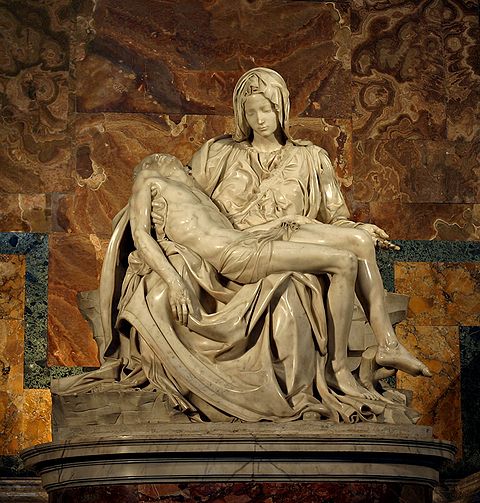
What is amazing to me about Jesus is not that he suffered, but that he knew he was going to suffer and he chose to go through it 480px-Michelangelo's_Pieta_5450_cropncleaned_editanyway.

As a young Jewish man he certainly would have read (and likely memorized) scriptures like Psalm 22. He would have meditated on words like:

My God, my God, why have you forsaken me?

Why are you so far from saving me, so far from my cries of anguish?

My God, I cry out by day, but you do not answer, by night, but I find no rest.

But I am a worm and not a man, scorned by everyone, despised by the people.
All who see me mock me; they hurl insults, shaking their heads.“He trusts in the Lord,” they say, “let the Lord rescue him.
Let him deliver him, since he delights in him…

Do not be far from me, for trouble is near and there is no one to help. Many bulls surround me; strong bulls of Bashan encircle me. Roaring lions that tear their prey open their mouths wide against me. I am poured out like water, and all my bones are out of joint. My heart has turned to wax; it has melted within me. My mouth is dried up like a potsherd, and my tongue sticks to the roof of my mouth; you lay me in the dust of death…

Dogs surround me, a pack of villains encircles me; they pierce my hands and my feet. All my bones are on display; people stare and gloat over me. They divide my clothes among them and cast lots for my garment.


Jesus would have read those words and known that, as God’s Messiah, those words applied directly to himself. Every day that Jesus read the Scriptures he looked into his future. Every day he read those words he had a choice to make: run away from suffering or choose to go through it.

Of course this suffering was not thrust upon Jesus. Before the creation of the world, Jesus as the Son of God chose suffering as the effective means of salvation for all who would put their trust in him. And even in his earthly ministry Jesus says, “No one takes [my life] from me, but I lay it down of my own accord. I have authority to lay it down and authority to take it up again” (John 10:18). And in Hebrews 12:2 we are told, “For the joy set before him, [Jesus] endured the cross, scorning its shame, and sat down at the right hand of the throne of God.”

Before God spoke the words “let there be light” Jesus chose to suffer.  He chose to be humiliated, to be abandoned, to endure unimaginable pain. On earth he chose to be reminded of that future suffering from the moment he could read. Jesus knew what was coming and chose to go through it anyway.

Why?

Jesus was also interested in a bonding experience.  But he wanted more than just to make memories with friends. He wanted to see rebels of God become children of God.  He wanted to see sinners turned into saints. He wanted to do for people what they could not do for themselves. He wanted to take upon himself the suffering we not only deserve but so desperately try to avoid. Jesus chose to suffer so that one day we wouldn’t have to.


Wonderful, Merciful Savior


Wonderful, merciful Savior
Precious Redeemer and Friend
Who would have thought that a Lamb
Could rescue the souls of men
Oh, You rescue the souls of men

Counselor, Comforter, Keeper
Spirit we long to embrace
You offer hope when our hearts have
Hopelessly lost our way
Oh, we’ve hopelessly lost the way

You are the One that we praise
You are the One we adore
You give the healing and grace
Our hearts always hunger for
Oh, our hearts always hunger for

Almighty, infinite Father
Faithfully loving Your own
Here in our weakness You find us
Falling before Your throne
Oh, we’re falling before Your throne

You are the One that we praise
You are the One we adore
You give the healing and grace
Our hearts always hunger for
Oh, our hearts always hunger for

You are the One that we praise
You are the One we adore
You give the healing and grace
Our hearts always hunger for
Oh, our hearts always hunger for

16 Gospel Verses Worth Memorizing


  1. “He was pierced for our transgressions, he was crushed for our iniquities; the punishment that brought us peace was upon him, and by his wounds we are healed” (Isaiah 53:5).
  1. “For even the Son of Man did not come to be served, but to serve, and to give his life as a ransom for many” (Mark 10:45).
  1. “God so loved the world that he gave his one and only Son, that whoever believes in him should not perish but have Bible_and_Key_Divinationeternal life” (John 3:16).
  1. “All the prophets testify about him that everyone who believes in him receives forgiveness of sins through his name” (Acts 10:43).
  1. “Through Jesus the forgiveness of sins is proclaimed to you. Through him everyone who believes is justified from everything you could not be justified from by the Law of Moses” (Acts 13:38–39).
  1. “He was delivered over to death for our sins and was raised to life for our justification” ( Romans 4:25).
  1. “But God demonstrates his own love for us in this: while we were still sinners, Christ died for us” ( Romans 5:8).
  1. “Christ died for our sins, according to the Scriptures … he was buried.… The third day he rose again from the dead, according to the Scriptures … and he appeared” (1 Cor. 15:3–6).
  1. “God was in Christ, reconciling the world to himself, not counting men’s trespasses against them” (2 Cor. 5:19).
  1. “God made him who knew no sin to be sin for us, that we might become the righteousness of God in him” (2 Cor. 5:21).
  1. “Remember Jesus Christ, raised from the dead, descended from David. This is my Gospel” (2 Tim. 2:8).
  1. “[He] gave himself for us to redeem us from all wickedness and to purify for himself a people that are his very own, eager to do what is good” (Titus 2:14).
  1. “Christ was sacrificed once to take away the sins of many people; and he will appear a second time, not to bear sin, but to bring salvation to those who are waiting for him” ( Hebrews 9:28).
  1. “He himself bore our sins in his body on the tree, so that we might die to sins and live for righteousness; by his wounds you have been healed” (1 Peter 2:24).
  1. “Christ died for sins once for all, the righteous for the unrighteous, to bring you to God” (1 Peter 3:18).
  1. “This is love: not that we loved God, but that he loved us and sent his Son as an atoning sacrifice for our sins” (1 John 4:10).


This list comes from the book Grounded in the Gospel…


The One Big Difference Between Christians and Jehovah’s Witnesses


The other morning I was cleaning the kitchen when I heard a knock at my front door. I thought it was strange since the only people who usually knock on our front door are friends and neighbors—and they were all at work or school.

I opened the door and, to my surprise, I was greeted by a well-dressed elderly man. He’d come to invite me to an event at his church. He was kind and friendly. Yet something felt off when he said, “You know, a lot of people think the resurrection of Jesus is the most important part of the Easter story, but actually it’s his death that is most significant.”Watchtower_Bible_&_Tract_Society_(world_headquarters)

I replied, “Well, yes, His substitutionary atonement was significant…” He didn’t react. And that was okay because behind me was my three-year-old son waving a broom like a Color Guard charging into battle…so I had to go before something or someone got hurt.

The gentleman put a booklet in my hand with some information about the event and then left. I opened it and saw that the booklet was a “Watchtower” production inviting people to come to the local “Kingdom Hall.” “Oh, he’s a Jehovah’s Witness,” I thought.

Now, to be honest, I don’t know a lot about Jehovah’s Witnesses. I can’t tell you every tenet of their theology or what it’s like to attend one of their “churches”. They seem like nice people. And they seem really committed to their beliefs. But I do know one big difference between Christians and Jehovah’s Witnesses. And it’s a difference that breaks my heart.

According to their website, www.jw.org, Jehovah’s Witnesses believe “God created Jesus before he created Adam.” For them, Jesus is the literal firstborn of creation. Simply put, God the Father is eternal. God the Son [Jesus] is not. Which means, for them, Jesus is not fully God in the same way God the Father is fully God. Instead Jesus is “the divine Son of God” and Jehovah is “the only true God.”

To be fair, people have believed such things about Jesus since Jesus first walked the earth. But in 325 AD at the Council of Nicaea Christian leaders from around the world agreed that such a belief was not biblical. At that meeting they affirmed that Scripture teaches and Christians believe that there is

“…one Lord Jesus Christ, the Son of God, begotten of the Father, the only-begotten; that is, of the essence of the Father, God of God, Light of Light, very God of very God, begotten, not made, being of one substance with the Father.”

The big difference between Jehovah’s Witnesses and Christians is that Christians believe that Jesus is fully God and Jehovah’s Witnesses do not.

Why does this matter?

If Jesus is not God, then Jesus sinned. And if he sinned then his sacrifice cannot save us.

In John 10:30 Jesus proclaims to the Jewish authorities, “I and the Father are one.” Now, just in case there was any question about what he meant in that statement, the next few verses make it clear:

“Again his Jewish opponents picked up stones to stone him, but Jesus said to them, ‘I have shown you many good works from the Father. For which of these do you stone me?’ ‘We are not stoning you for any good work,’ they replied, ‘but for blasphemy, because you, a mere man, claim to be God.’” (John 10:31-33)

The Jews knew he was claiming to be God. And Jesus did not correct them.

Similarly, after Jesus had been raised from the dead, his deity is affirmed. When Jesus appeared before Thomas (aka Doubting Thomas), Thomas was so taken aback that he worships Jesus saying, “My Lord and my God!” (John 20:28)

Again, Jesus does not correct him. Jesus, it seems, believed that he was, in every way, God.

Now, if Jesus knew that God the Father [Jehovah] was “the only true God” then Jesus committed the sin of blasphemy when he let people think he was equal to and worthy of the same worship as “the only true God.”

This is a real problem.

For if Jesus sinned [by committing blasphemy], it means Jesus’ sacrifice/atonement on our behalf was meaningless. Because a person in debt has no means to pay the debt of others. So, too, a sinner cannot pay the debt of other sinners. Only a perfect and righteous person has the means to pay off the debts of sinful people.

It is true that Jehovah’s Witnesses claim that Jesus was sinless. But if Jesus wasn’t fully God that can’t be true.

The important question is, was Jesus right to let people think that he was God and worship him?

If he was fully God—Yes!

If he was not fully God—No!

If Jesus was not fully God then Jesus sinned. Period.

This is why the one big difference between Christians and Jehovah’s Witnesses breaks my heart.

Jehovah’s Witnesses have put their trust in a version of Jesus—a Jesus that may be son of a god, but who is actually not really a god at all. And because of that, they are looking for salvation from one who does not have the power to save them.

Only a Jesus that is in every way God is worthy of our worship. Only a Jesus that is in every way God has the righteousness to pay for our sin. Only a Jesus that is in every way God can actually save us.

And so I pray for the gentleman who came to my front door. I  pray that he will come to know Jesus—the real Jesus. And I pray that one day he might come to Jesus and, without reservation, say, “My Lord and my God.”


To learn more about Jehovah’s Witnesses and how you can respond when they come to your door, check out https://carm.org/jehovahs-witnesses