Family Worship

“What do you do for family worship?”

That was the question I asked my volunteer leaders about six months ago. I asked not because I wanted to check up on their family’s spiritual health. I asked because I was honestly looking for ways in which I could lead my family in worship.

Growing up, my family (although Christian) did not practice family worship. And even though I am a pastor, the idea of worshiping with my family by ourselves at home still feels a little awkward. We have, for a while, prayed together at night, and often even read the Bible together. But I still felt like I wasn’t very good at it. There were restless kids constantly getting up and down. There was yelling. There was crying. There were stuffed animal friends missing.   There was fighting over what to read and who got to hold what. There were tantrums so dramatic that I was tempted to cast out demons.
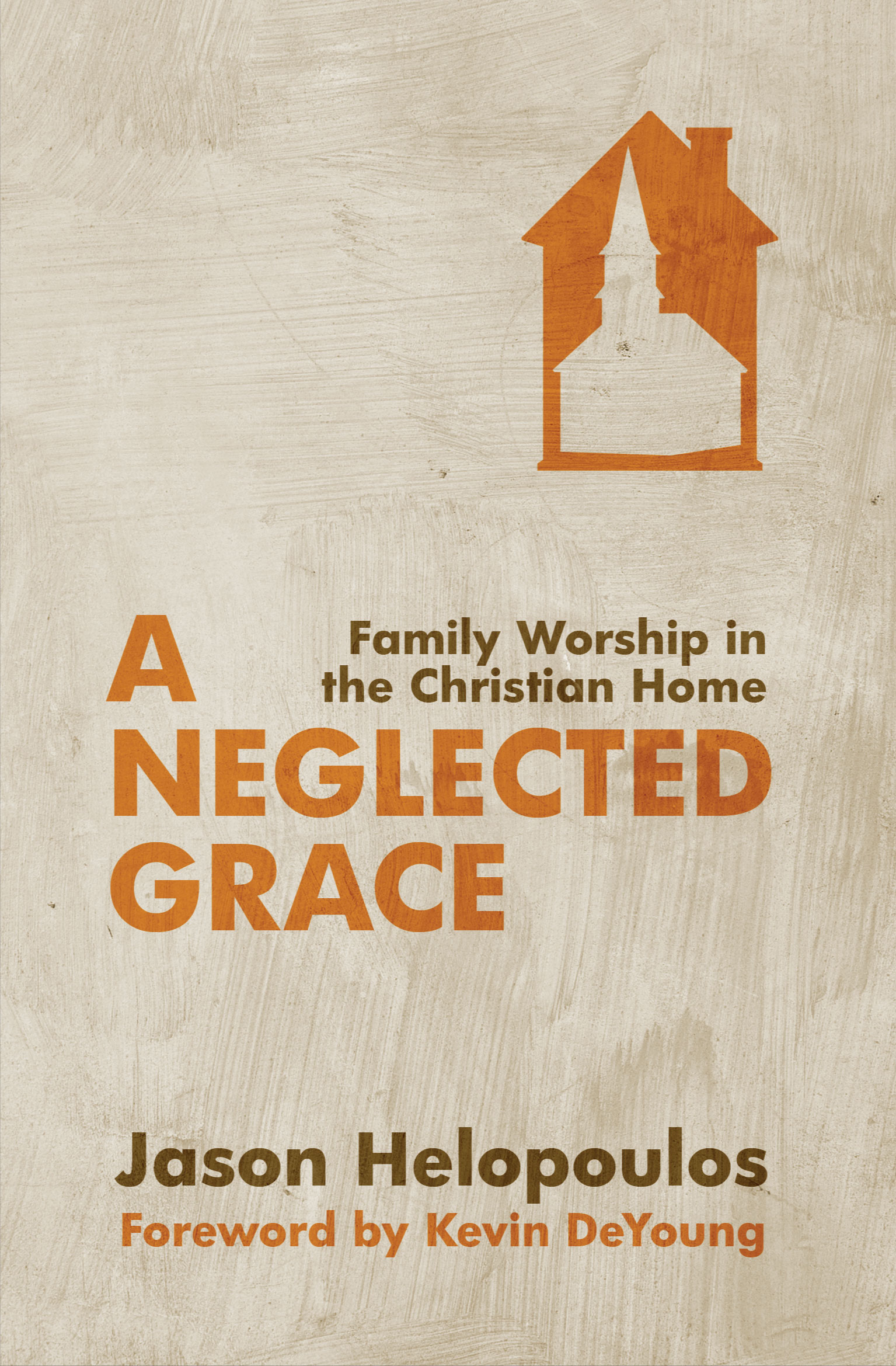
Then I came across an excellent book entitled A Neglected Grace: Family Worship in the Christian Home by Jason Helopoulos (yeah, I’m not sure how pronounce his last name either). Now the book didn’t magically fix everything. But it has given me a much better paradigm and model for family worship. And it is a book I would highly recommend to you for five reasons.

  1. It’s short. At 126 pages you could easily read it in a week.
  2. It’s biblical. Jason gives a great overview of family worship in the Bible, and demonstrates, from the Bible, why family worship is worth pursuing today.
  3. It’s relatable. Jason knows that, for most people, family worship is new and out of their comfort zone. So he provides real-life testimonies from regular families on the benefits of family worship.
  4. It’s incredibility practical. Jason offers some great practical models of what family worship can look like. He even has age-appropriate discussion questions for parents to ask their children as they read through the Bible.
  5. It’s from a perspective of grace. Jason is not challenging parents to add one more thing to their already full plate. For him, “Family worship is an instrument through which God gives us grace…It is not something that should be a burden. It is a joy.” Jason’s desire throughout the book is to help families experience more of God’s grace.

If you’re a parent or grandparent who wants to see your family grow in God’s grace, I would encourage you to get this book.

Family worship is by no means perfect at our house. But I can already see the benefits of making the effort. I love hearing my kids sing worship songs, I love hearing my kids pray, and I love hearing my oldest read the Bible. Every night these things happen we experience God’s  grace in our family.


Lord Please Keep Making Me

Make me broken
So I can be healed
‘Cause I’m so calloused
And now I can’t feel
I want to run to You
With heart wide open
Make me broken

Make empty
So I can be filled
‘Cause I’m still holding
Onto my will
And I’m completed
When you are with me
Make me empty

[Chorus:]
‘Til You are my one desire
‘Til You are my one true love
‘Til You are my breath, my everything
Lord, please keep making me

Make me lonely
So I can be Yours
‘Til I want no one
More than You, Lord
‘Cause in the darkness
I know You will hold me
Make me lonely

[Chorus]

Charles Spurgeon on David’s thirst for God

“It is a precious thought that the divine power and glory are not confined in their manifestation to any place or localities; they are to be heard above the roaring of the sea, seen amid the glare of the tempest, felt in the forest and the prairie, and enjoyed whenever there is a heart that longs and thirsts to behold them. Our misery is that we thirst so little for these sublime things, and so much for the mocking trifles of time and sense. We are in very truth always in a wary land, for this is not our rest; and it is marvelous that believers do not more continuously thirst after their portion far beyond the river where they shall see the face of God, and his name shall be in their foreheads. David did not thirst for water or any earthly things, but only for spiritual manifestations. The sight of God was enough for him, but nothing short of that would content him. How great a friend is he, the very sight of whom is consolation. Oh my soul, imitate the psalmist, and let all thy desires ascend toward the highest good; longing here to see and having no higher joy even for eternity.”[1]


[1] Charles H. Spurgeon. The Treasury of David pp134-135, commenting on Psalm 63:1-2

John Piper on The Essence of Evil

God defines evil this way when he says, “My people have committed two evils: they have forsaken me, the fountain of living waters, and hewed out cisterns for themselves, broken cisterns that can hold no water” (Jer. 2:13). God pictures himself as a mountain spring of clean, cool, life-giving water. The way to glorify a fountain like this is to enjoy the water, and praise the water, and keep coming back to the water, and  point other people to the water, and get strength for love from the water, and never, never, never prefer any drink in the world over this water. That makes the spring look valuable. That is how we glorify God, the fountain of living water.”… So preferring the pleasures of money or power or fame or sex over the “pleasures . . . at [God’s] right hand” (Ps. 16:11) is not like preferring caramel to hot fudge. It is a great evil. Indeed it is the ultimate meaning of evil. Esteeming God less than anything is the essence of evil.

Finding Peace: Week Four of Advent

I think I may have missed my calling to be a beauty pageant contestant—because I sincerely desire world peace.

But is world peace even possible?

Our society feeds on conflict. Whether it’s 24 hours of almost entirely negative news, inflammatory political rants from talk-radio hosts, or the latest firestorm on social media about the actions of a celebrity. It is all just noise that spoons conflict into our lives. We eat it up. And we can’t get enough of it.

Then we complain about it. We love to complain about it. We love to tell anybody who will listen, and many people who don’t want to listen, what in the world (or at least our world) is messed up.

And this of course breeds stress, anxiety, and anger, in our lives and the lives of others. With the result, that each day our world becomes a little less peaceful.

But we say it’s not our fault:

If only those people over there would stop doing….then there would be peace.

If only that leader would start doing…then there would be peace.

If only this or that person would change…then, the world, our families, and our lives would be peaceful.

But God’s Word tells us something different.

Peace is not dependent on the actions of others. Peace comes to us when we enter into the presence of the Prince of Peace, Jesus Christ.

Paul’s Perspective

The Apostle Paul shows us what this looks like. While confined to house arrest in Rome, he wrote the following encouragement to a suffering church in Philippi:

Rejoice in the Lord always. I will say it again: Rejoice! Let your gentleness be evident to all. The Lord is near. Do not be anxious about anything, but in every situation, by prayer and petition, with thanksgiving, present your requests to God. And the peace of God, which transcends all understanding, will guard your hearts and your minds in Christ Jesus.

Finally, brothers and sisters, whatever is true, whatever is noble, whatever is right, whatever is pure, whatever is lovely, whatever is admirable—if anything is excellent or praiseworthy—think about such things. Whatever you have learned or received or heard from me, or seen in me—put it into practice. And the God of peace will be with you. (Philippians 4:4-9)

Did you catch Paul’s recipe for peace?

Peace comes through joyful worship of Jesus (4)

Rejoice in the Lord always. I will say it again: Rejoice!

Peace comes through prayerful reliance on God through Jesus (6-7)

Do not be anxious about anything, but in every situation, by prayer and petition, with thanksgiving, present your requests to God. And the peace of God, which transcends all understanding, will guard your hearts and your minds in Christ Jesus.

Peace comes through the enjoyment of the things of God (8-9)

Finally, brothers and sisters, whatever is true, whatever is noble, whatever is right, whatever is pure, whatever is lovely, whatever is admirable—if anything is excellent or praiseworthy—think about such things...And the God of peace will be with you.

The point is, despite our circumstances, peace is available to us now.

It is true that this is not the same kind of peace we will have in heaven. Now, our peace is fleeting. In heaven it will be continual. But the peace we experience in heaven will come from doing the same kind of things we are now able to do on earth. That is, the continual worship, reliance, and enjoyment of Jesus Christ.

What Paul knew is that, as long as we have access to Jesus, we have access to peace- the peace of God, that transcends all understanding.

So if you, like me, sincerely desire peace, then join me this week and come into the presence of the Prince of Peace, Jesus Christ.

Let’s turn off our 24-hour news channels. Let’s change the station on our political talking heads. And lets take a breather from our social media outrage.

And instead, lets spend time praising Jesus, relying on Jesus, and enjoying the gifts of Jesus–then we might just taste the beginnings of world peace.


For to us a child is born,
to us a son is given,
and the government will be on his shoulders.
And he will be called
Wonderful Counselor, Mighty God,
Everlasting Father, Prince of Peace.
Of the greatness of his government and peace
there will be no end.

(Isaiah 9:6-7)


Advent: A Different Kind of Waiting (Week 2)

Pop quiz.

What is one of the best antidotes to holiday stress?

Answer? Waiting.

No, really. The answer is waiting.

I think one of the reasons you and I get so overwhelmed during the Christmas season is because we are terrible at waiting, and we hate it when we are forced to practice it.

But being forced to wait is often God’s preferred method to help us keep our sanity. How is it that, when I have so much to do, waiting helps me keep my sanity?

That’s the subject of this week’s Advent: A Different Kind of Waiting post, where I share some of the best Advent posts from around the Web.

In a thought-provoking post, Wheaton College Professor Dr. Marc Cortez reminds us that waiting can change the way we view our time. He provides us with five great ways being forced to wait can be a blessing. I particularly like his fourth point:

4. Waiting reminds us that the present matters.

Sometimes I think waiting frustrates us because we’re too future-oriented, always focused on what comes next. But what about now? Next is in God’s hands. Now is what we have. Done well, being forced to wait can be like watching a particularly spectacular movie scene in slow motion. You know the movie will continue playing at regular speed soon, but for now you’re just enjoying what’s on the screen.

I don’t know about you, but I need to hear that just about every day.

The rest of the post is just as good. So click below and enjoy this timely, hidden gem of a devotional by Dr. Cortez. Let it change the way you view your time this Advent  season. Then come back and share with us which of Marc’s points resonated most with you.

Blessings!

Forced to Wait: An Advent Reflection

by Marc Cortez December 17, 2012


Advent… A Different Kind of Waiting

Once, as a Boy Scout traveling to a campground many hours away, I purchased a bucket of Coke at a pit stop (66 ounces to be exact) and drank it all in the following thirty minutes. At which point all 66 ounces of soda decided that they wanted to come out—the only problem was we were still two hours away from our destination and our driver was not going to stop. And so I waited. And waited. And waited.  I waited as we drove up thousands of feet on mountain roads. I waited as my friends enjoyed watching me squirm as they told jokes about waterfalls. And I waited as I literally felt my insides expand to their breaking point.  It was the first time I thought my bladder was actually going to burst, and truthfully, in that moment, if it had happened I would have been happy.

Finally, after what seemed like an eternity, we came to a stop in front of a rustic, public restroom. I jumped out of the van, ran/waddled, to the door of beckoning freedom. With each step I fumbled with my my scout belt, trying to get it off before I entered the stall. Then terror ensued. My scout belt was stuck.

The belt was not your typical belt. It was the kind that had a square box with a metal pin in it to keep the belt cord from moving. And that two-inch pin was stuck—jammed sideways and not moving. I started to panic, my legs went numb, and my mind raced for a solution, as all the while I tugged for dear life on that little metal pin that stood between me and ethereal relief.

I stared at the white porcelain seat that had once been my hope and refuge, but now only seemed to mock me in my plight. So close, yet so far away. The pressure mounted, my hand started to shake, and sweat like dew covered my flushed face. I thought, it’s over. I began to resign myself to the inevitable end that I was going to have to let all 66 ounces out into my pine green scout shorts and onto the grey wood floor. But then it happened. By sheer miracle, that little brass pin moved and my scout belt flung open. And there, in a wooden shelter of a bathroom, I stood in victory… for at least ten minutes.

The season of Advent is about waiting, but thankfully it is a different kind of waiting.

In God’s kingdom, waiting isn’t meant to be an excruciating, painful, no-end-in-sight delayed experience, like a liquid-filled Boy Scout waiting for relief. Rather, waiting, for God’s children, is meant to be something entirely different, something of a blessing.

How can that be? Over the next four Mondays I’ll share what I consider to be some of the best Advent post from around the Web, all addressing the blessing of waiting.  My hope is that it will change the way you and I think about waiting and about the season of Advent.

First up, a fantastic article by Rob Bell.  Now, I definitely do not agree with everything Rob Bell has written in recent years. But back before he kissed evangelical theology goodbye, he wrote a very good article about Advent and the Church Calendar. It is Rob Bell at his best, and, for every Christian, an article worth reading.  So click on the link below and read the article, then come back and share your thoughts in the comment section. Enjoy!


Why Should We Care About Advent? By Rob Bell November 29, 2010


Next week, a post from  Marc Cortez (Associate Professor of Theology at Wheaton College)

________________________________________________________________________________

For those looking for some good Advent resources, here are a couple of inexpensive, but helpful books:

(Download this one for free at www.desiringgod.org)

Thankful For Play

“Play is not a major emphasis in the Bible and it can be unhelpful to encourage play in a culture that so often and easily trivializes God and life itself. Yet, I do believe that a sense of play is necessary for a healthy Christian perspective on life. The failure to appreciate play in the Christian life could easily turn piety into sanctimony, reverence into rigidity, and sanctification into stuffiness. We must take God as seriously as we can, but never ourselves.

God invites us to approach him as his free, forgiven, secure children. We are to approach our holy God with healthy fear and hearts broken by our broken world. But God’s people are also called to rejoice, sing, play, and laugh because we know that the owner of all things is working out his perfect plan that ends with a wedding banquet and perfect resolution and rest. This sure hope in God’s sovereign power and loving-kindness enables us to play with reckless abandon, even before the Great Wedding Banquet begins.”

Why pursue Jesus now?

Why not enjoy life now, do whatever I want and then pursue Jesus later…after I’ve had all my fun? This was the question we discussed last night at our high school group. It’s is a good question, one I  thought about in high school and have since thought about as an adult.  For most of us if we’re honest we’d admit that there are times when we see others “enjoying” life apart from God and we can’t help but think— why can’t I do that and then ask for forgiveness later?

But the question is usually asked when we’re not thinking about three things…

1.  I am not in control of when I die.

God says in James 4:13-14

13 Now listen, you who say, “Today or tomorrow we will go to this or that city, spend a year there, carry on business and make money.” 14 Why, you do not even know what will happen tomorrow. What is your life? You are a mist that appears for a little while and then vanishes.

No one has control over their tomorrow.  We can make plans but ultimately our life is in God’s hands.  My family became painfully aware of this truth last fall when my wife’s mother died unexpectedly of a brain aneurism.  She was healthy, full of life, and we should have had many more years with her. But instead our lives were turned upside and we were forced to come to terms with a new reality.

Medical emergencies, car accidents, and even school shootings are everyday reminders that we are not in complete control of our mortality.  So when we assume that we’ll have many tomorrows in order to turn our lives around we’re making a pretty foolish assumption.

2.  God has good things for me to do now

Ephesians 2:10  says, For we are God’s handiwork, created in Christ Jesus to do good works, which God prepared in advance for us to do.

This is one of the greatest promises of God.  If I have given my life to Jesus, then I can know that Jesus has prepared good things for me do. I can literally wake up every morning and say to God, “Would you lead me to the good things you have for me today”. My job, then, is simply to be faithful to where God’s leads me.  The reason I pursue Jesus isn’t just to avoid negative consequences, but rather to enjoy watching God do good things through me.

3.  In Jesus I have access to joy–all the time

This leads to the third truth, in Jesus there is joy—all the time.

Psalm 16:11- You make known to me the path of life; you will fill me with joy in your presence, with eternal pleasures at your right hand.

In the presence of Jesus there is joy.  Now what I didn’t know in high school was that this verse does not mean that Jesus will fill my life with joyful things.  Instead it means, despite the suffering that may come from external circumstances, there is joy when I acknowledge the presence of Jesus over all my life and chose to praise Him–no matter the situation.

This is actually an amazing experiment to try sometime. Wait till you’re angry, frustrated, sad, depressed, anxious, or stressed out of your mind…and then start worshiping Jesus. Seriously.  Start with the simple stuff, like “Jesus I thank you for giving me a mind, and thoughts, and the ability to think. Jesus I praise you for color and giving me eyes to see it. Jesus I praise for creating good flavors and the ability to enjoy food. Jesus I praise you for the trees outside that look like they are lifting their arms to worship you” …whatever comes to your mind.  As you do this you will literally feel your heart soften, and the beginnings of joy enter in. It is this secret of life that led the Apostle Paul to exclaim, Rejoice in the Lord always. I will say it again: Rejoice! (Philippians 4:4), while suffering in prison. Jesus is worth pursing now, because He offers joy now.

Life maybe short and unpredictable, but in Jesus we know that there are good things planned for us and joy in His presence–now and forever.

When have you been tempted to ask, why can’t I sin now and then ask for forgiveness later? How have you experienced the joy of Jesus’ presence? What has motivated you to pursue Jesus?

Discipleship as Worship

photo credit: Lawrence OP via photopin cc

photo credit: Lawrence OP via photopin cc

The goal of discipleship is worship– whole-life worship as described by Jesus in Mark 12:30:

“…Love the Lord your God with all your heart and with all your soul and with all your mind and with all your strength.”

According to Carson’s and Beale’s, Commentary on the New Testament Use of the Old Testament (which by the way is awesome), the following is true:

To love God with your Heart = Loving God with your moral choices/character

To love God with your Soul = Loving God to the risk of one’s life

To love God with your Mind = Loving God with your thoughts

To love God with your Strength = Loving God with your possessions

Now look at the words Jesus uses to call people to be His disciples:

Therefore everyone who hears these words of mine and puts them into practice is like a wise man who built his house on the rock” (Matthew 7:24)

Then Jesus said to his disciples, “Whoever wants to be my disciple must deny themselves and take up their cross and follow me. For whoever wants to save their life will lose it, but whoever loses their life for me will find it. (Matthew 16:24-25)

To the Jews who had believed him, Jesus said, “If you hold to my teaching, you are really my disciples.  Then you will know the truth, and the truth will set you free.”(John 8:31-32)

Just then a man came up to Jesus and asked, “Teacher, what good thing must I do to get eternal life?”… Jesus answered, “If you want to be perfect, go, sell your possessions and give to the poor, and you will have treasure in heaven. Then come, follow me.” (Matthew 19:16, 21)

In each of case (and many more like these) Jesus is simply calling people to live out Mark 12:30.  That is to worship Him (as God) with all their Heart (choices), Mind (thoughts), Soul (life) and Strength (possessions).

For those of us in leadership positions our goal is the same, to lead people to the joyful worship of the Triune God– this is true discipleship.

How do you lead people in whole-life worship of God?